A brief analysis on the New Brunswick connection to British women’s right to vote
Background on Bonar Law
Andrew Bonar Law was born in Rexton, New Brunswick in 1858. He moved to Scotland with his aunt Janet at the age of 12 and would eventually become a very successful Member of the British Parliament, even becoming the first Prime Minister of the United Kingdom to be born outside the British Isles.
First elected in 1900 Bonar Law was a member of the conservative party. However, for much of Bonar Law’s time as a politician it was the liberals who were in power primarily under Prime Minister H. H. Asquith. In 1903 the Women’s Social and Political Union (WSPU) was formed in Britain with the goal of campaigning for women’s suffrage. In Ireland a similar group, the Irish Women’s Franchise League (IWFL) emerged in 1908 with a similar goal of pushing for women’s suffrage. The latter would be far less involved in militancy for their cause, preferring a more diplomatic and constitutional approach. The IWFL also created their own suffragette newspaper titled The Irish Citizen in which they advocated for the suffragist movement and to further the cause of Feminism in Ireland.
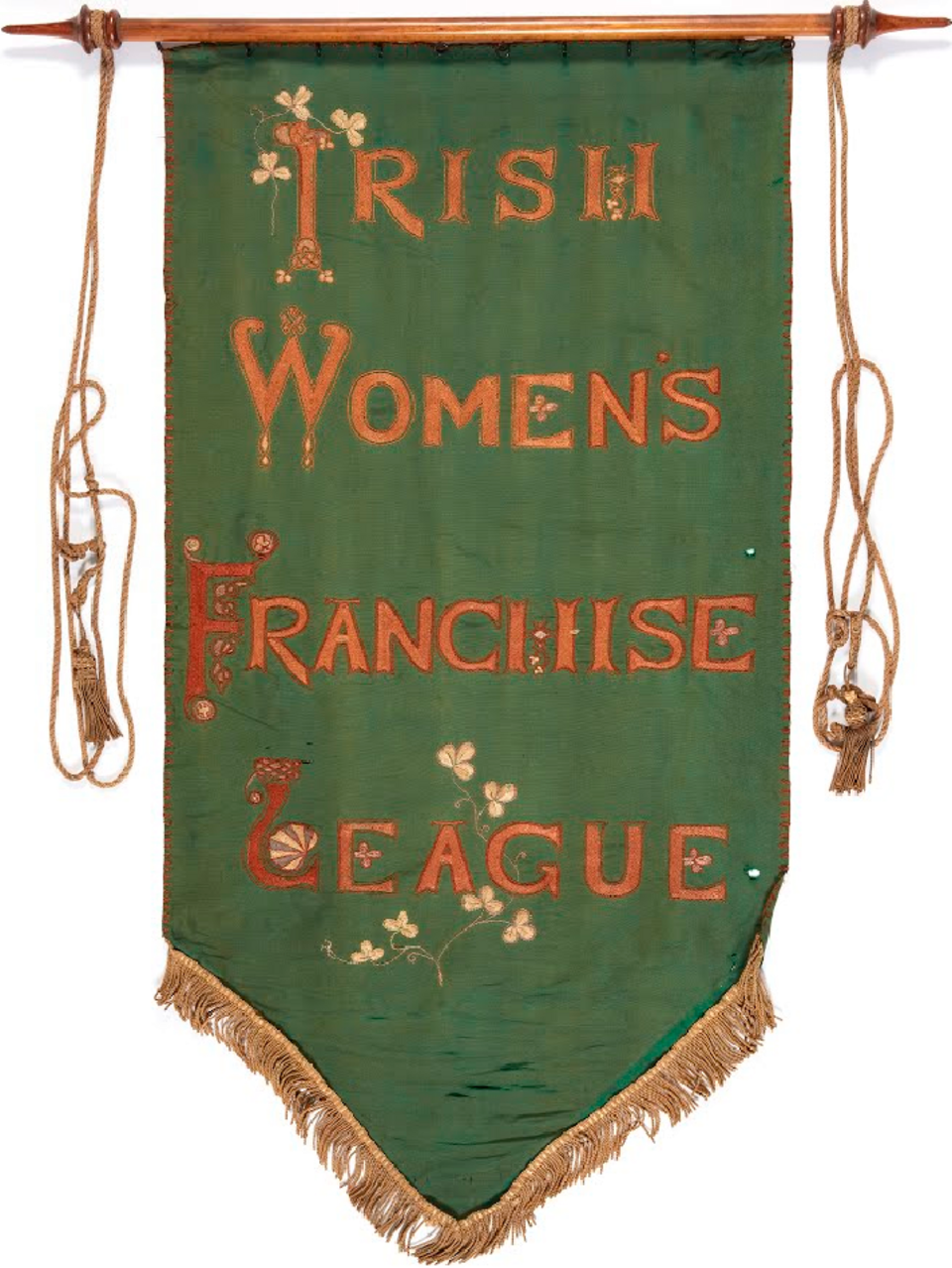
Irish Women’s Franchise League banner circa late 1910’s
(Photo credit: public domain)
The political betrayal
During this time, the Irish Parliamentary Party (IPP) held the balance of power in the House of Commons. They formed an alliance with H. H. Asquith and in return they would get Irish Home Rule (self governance), introduced in 1912. Bonar Law was very opposed to home rule, instead being in favour of one government over the United Kingdom, many people who supported this idea were Unionists.
In regards to the women’s right to vote however, H. H. Asquith was vehemently opposed. The IPP worried that if they pushed for women’s suffrage, the alliance with Asquith and the liberals would fall apart leaving the conservative unionists to come to power and losing their chance of home rule. They opted for the politically motivated Home Rule Bill. This led many women in the IWFL to rely on activism to get the attention of the IPP and the British Parliament, in 1912, eight women were arrested for throwing stones at government buildings and sent to prison for one or two months. It’s safe to say that suffragettes in the United Kingdom were not afraid of using activism for their cause.
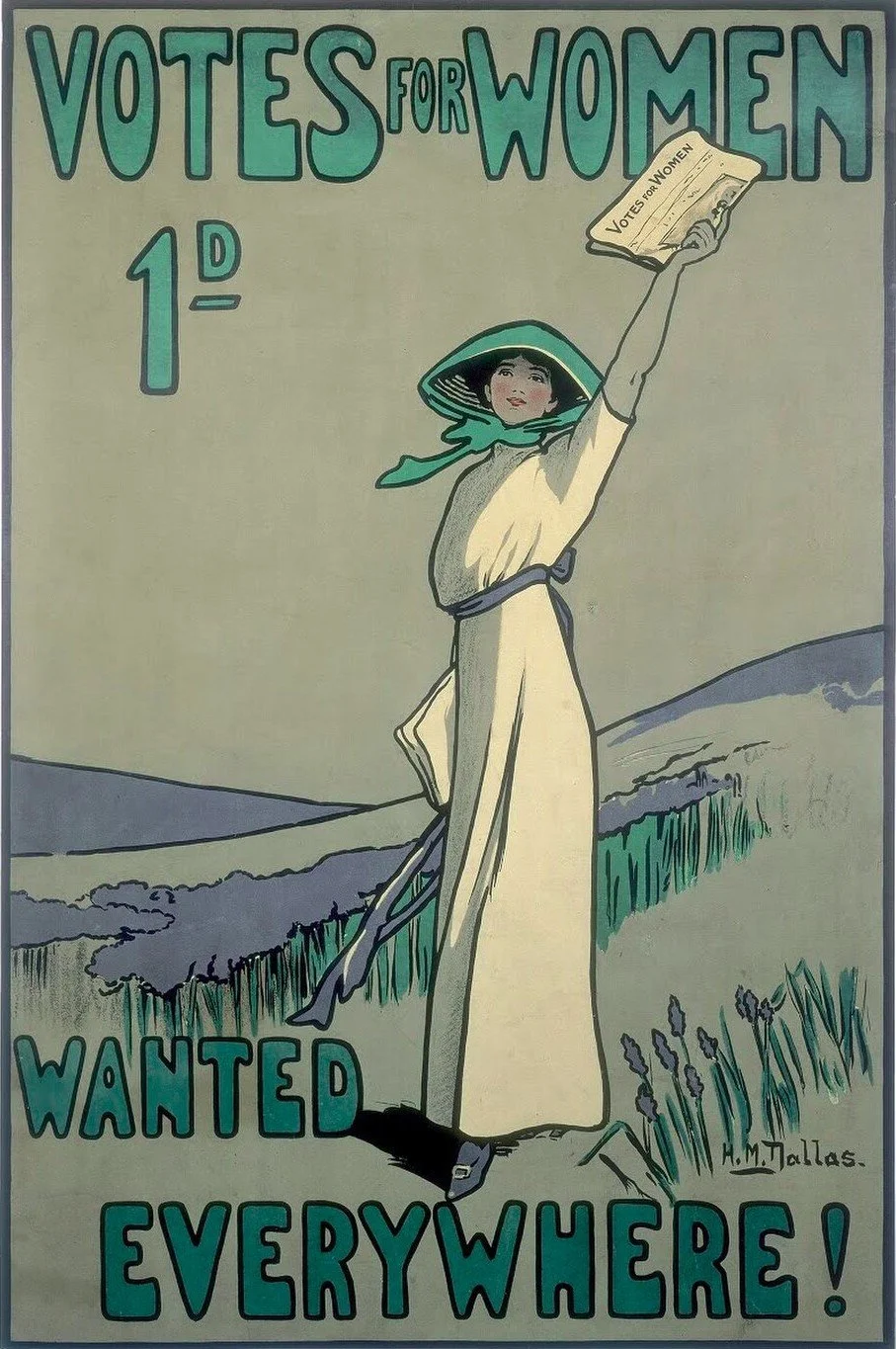
Women’s Social and Political Union poster from 1909
(Photo credit: Public Domain)
Bonar Law’s Stance
Bonar Law’s position on the matter always seemed sympathetic to the movement. Unlike some of his political colleagues like Edward Carson, Bonar Law felt as though women were deserving of equal voting rights. On the subject of the Franchise and Registration bill of 1913, Bonar Law’s outlook was that he was glad there will be a better opportunity to vote on the matter in the future as it was associated with other legislation all being voted on at once, which he felt was unfair and would have conflicts of interests among some parties.
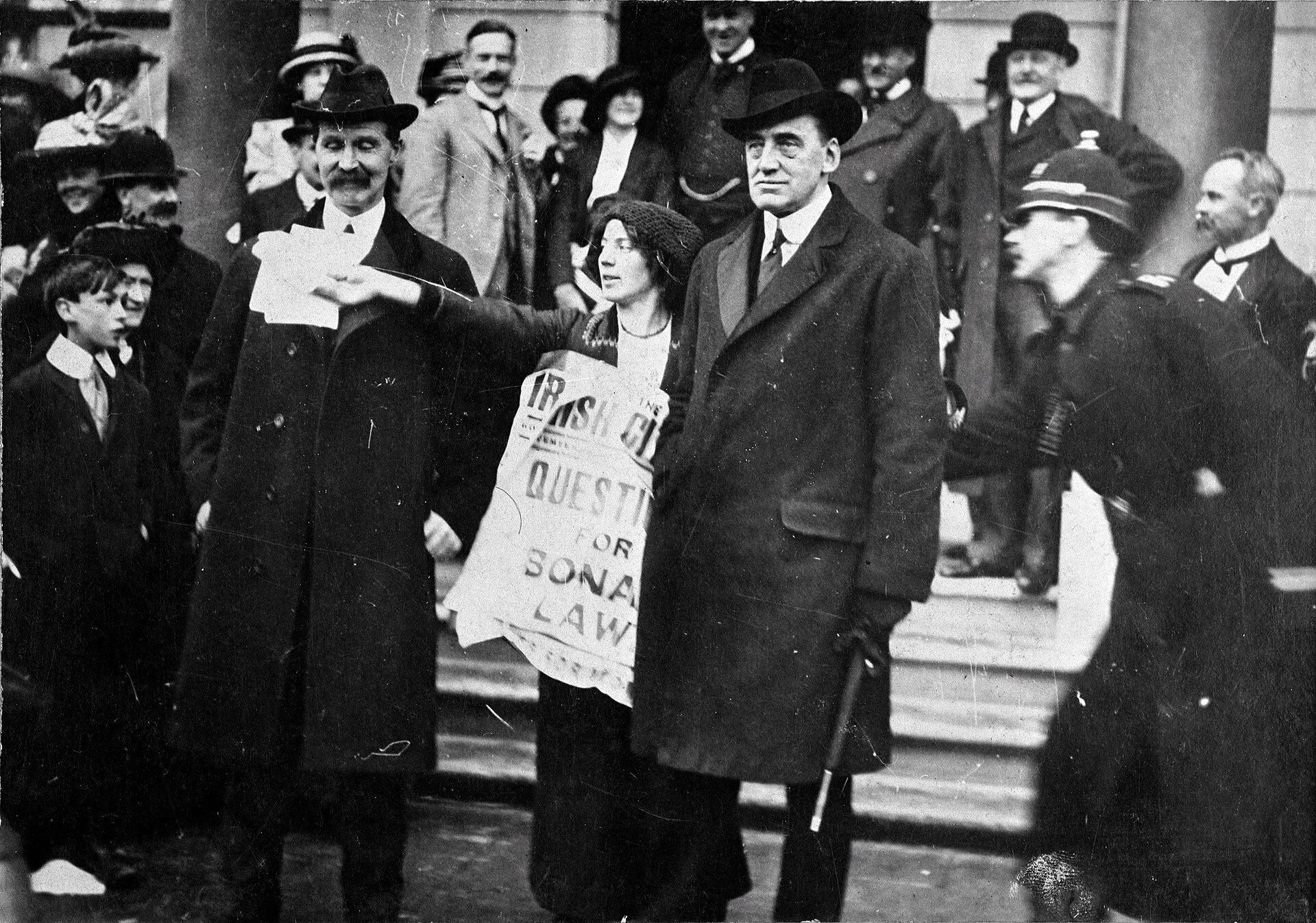
Suffragette Meg Connery waves copies of The Irish Citizen in front of Bonar Law and Edward Carson before being arrested, circa 1912
(Photo Credit: Public Domain)
In 1918 under the liberal government of David Lloyd George, Britain would pass the Representation of the People Act which gave women the right to vote as long as they were over the age of 30 and owned property. This however, still left roughly 1/3 of women in Britain without the right to vote, it also wasn’t equal to men who could vote at 21 and did not need to meet a property qualification. This inequality left the suffragettes to keep fighting for equal voting rights.
In 1922 Bonar Law is quoted as saying:
“I have been a consistent supporter of women's suffrage and even at the time that the Franchise Bill of 1918 was passed I felt that the discrimination in age between men and women could not be permanent. I think so still.”
Unfortunately this was more of a personal opinion rather than the official view of the conservative party at the time.
Getting the right to vote
Bonar Law would pass away in 1923, less than a year after he took office as Prime Minister, although he never got the chance to implement equal voting rights, perhaps this dialogue helped progress the conservative party’s stance on women’s suffrage.
British women would get the same and equal voting rights as men in 1928. Their strength and resilience still stands the test of time. Although Bonar Law did not have a long tenure as Prime Minister, one might query what he would have done in regards to women’s suffrage had he been given just a little more time.
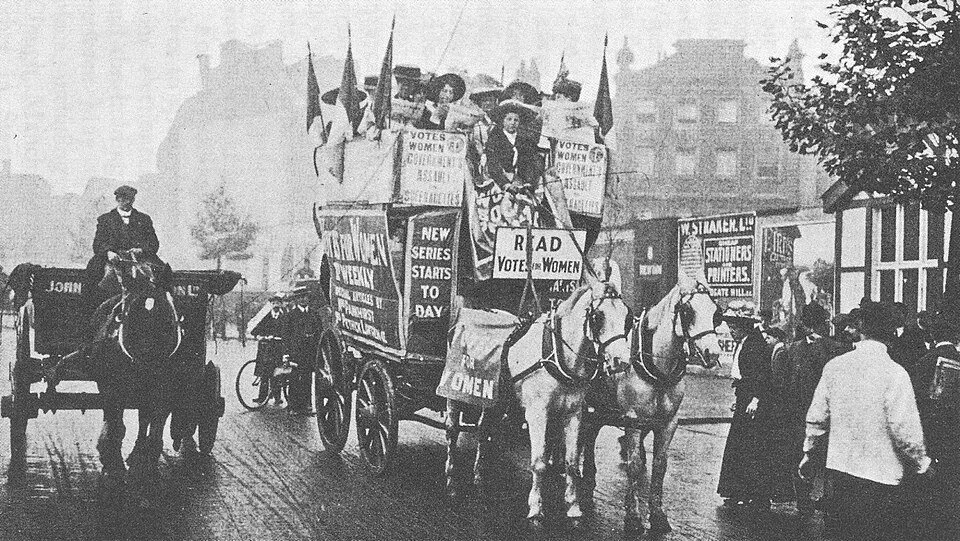
The Women’s Social and Political Union campaigning in Kingsway, London, circa 1911
(Photo Credit: Public Domain)
References and further reading:
“Women suftoage amendments” 27 Janurary, 1913, Vol 47, https://api.parliament.uk/historic-hansard/commons/1913/jan/27/women-suftoage-amendments
Takayanagi, M. (2018), Women and the Vote: The Parliamentary Path to Equal Franchise, 1918–28. Parliamentary History, 37: 168-185. https://doi.org/10.1111/1750-0206.12344
Smith, Karen Manners. "Women’s Social and Political Union". Encyclopedia Britannica, 29 Mar. 2024, https://www.britannica.com/topic/Womens-Social-and-Political-Union.
“Women get the vote” UK Parliament, https://www.parliament.uk/about/living-heritage/transformingsociety/electionsvoting/womenvote/overview/thevote/
“Read all about it: writing wrongs”. Louise Ryan, The Irish Times, October 17, 2012, https://www.irishtimes.com/culture/heritage/century/century-women-and-the-vote/read-all-about-it-writing-wrongs-1.553431